Monday, June 13, 2016

Limited Access to Electricity Interferes Economic Development

Power shortages still hamper areas nationwide: Jokowi

Mataram, West Nusa Tenggara | Mon, June 13 2016 | 09:45 am


Sufficient energy – President Joko “Jokowi” Widodo visits a mobile power plant (MPP) construction project in Jeranjang, West Lombok, West Nusa Tenggara, on Saturday.(Tempo/Supriyanto Khafid)
 
Although Indonesia’s economic growth is considered good and has received international praise, President Joko “Jokowi” Widodo has said he often feels ashamed by electricity shortages faced by provinces across the country.

“When I visited various countries, many countries praised our economic growth, through which we could survive the economic downturn [that affected] almost all countries across the globe,” the President said during a visit to Lombok, West Nusa Tenggara (NTB), on Saturday.

“Some countries exhibited negative growth while others experienced very low growth, and there were countries with a decline in their economies. They praised us but I myself felt ashamed because if they knew that in our provinces the electricity supply is still on and off [they would not commend us]. Power blackouts still happen frequently due to electricity supply shortages,” he said.
The President was speaking at a mobile power plant (MPP) project in Jeranjang, West Lombok, NTB, on Saturday.

Jokowi said electricity was a grassroots problem in Indonesia, which must be resolved as it had become a primary need in people’s lives.

“Electricity is needed for households that run sewing businesses, or small and medium enterprises. They need electricity to sew at night or to make snacks. Children need electricity to study at night. It will be difficult for them to work on their school assignments without electricity. This is a concrete problem faced by common people,” he said.

Jokowi said the government, through its 35,000 Megawatt (MW) electricity program, would continue to push the development of energy sources — primarily new and renewable — especially in regions with power shortages, including NTB.

The construction of the MPP project with a capacity of 2 x 25 MW in Jeranjang began earlier in the year, but the ground-breaking ceremony was only officially conducted during Jokowi’s visit on Saturday.

First Lady Iriana Widodo, state electricity firm PLN’s president director Sofyan Basir, Energy and Mineral Resources Minister Sudirman Said, State-Owned Enterprises Minister Rini Soemarno and NTB Governor M. Zainul Majdi also attended the ceremony.

“The MPP Jeranjang is a gas-fueled power plant so it is predicted it can save around Rp 26 billion [US$1.95 million] of state funds per year,” said Sofyan. The MPP Jeranjang is expected start to operating in September 2016. (ebf)

Access to Electricity can Significantly Change their Lives!


There's an example that clearly shows access to electricity can significantly change their lives!

Electricity Sparks Life into Northern Haiti


Rosette Joseph processes a customer's electricity bill in Caracol, Haiti, in May 2013.

Rosette Joseph processes a customer's electricity bill in Caracol, Haiti, in May 2013. A USAID project brought electricity to the community.Kendra Helmer, USAID
A new power plant is connecting thousands of households to reliable power for the first time, creating a productive revolution in Caracol Village and beyond.

Caracol is a small seaside village in northern Haiti where people have traditionally earned a living from fishing and collecting salt from the nearby plains. This village of over 2,500 residents is like any other rural community in Haiti with simple houses and dirt roads, but there is something that makes Caracol different.

In a country where most people don’t have any electrical power or receive it only sporadically, Caracol is the only community with a regular flow of electricity—24 hours a day, seven days a week—boosting its economy and helping families improve their lives. Before Caracol went on the grid, any electricity that was produced in the town came from self-run generators.

Achille Amiotte stands inside her restaurant in Caracol, Haiti, in May 2013.

Achille Amiotte stands inside her restaurant in Caracol, Haiti, in May 2013. She waited to open the restaurant until electricity became available in the area through a USAID rural electrification project.
Kendra Helmer, USAID
Northern Haiti is among the poorest regions of the country, where a quarter of residents suffer from extreme poverty, earning less than $1.25 per day.

“For the first time ever, my family has light in the house after sunset. Now my carpenter husband can extend his work hours and use power tools. The children are happy because they can do homework in the evenings and even watch TV,” said Yollande Noel, a Caracol resident.
Since May 2013, the $2 million Caracol Electrification Project, funded by USAID and implemented by NRECA (link is external), has wired 540 Caracol households. Over the next few months, the program will connect another 1,260 homes in the vicinity of the Caracol Industrial Park, including a U.S. Government-funded housing site intended for earthquake-affected and other vulnerable families living in the area. Expansion is planned for another 5,000 homes in the surrounding villages of Limonade, Trou du Nord and Terrier Rouge.

The Caracol Electrification Project is part of USAID’s $20 million program that built the 10 megawatt power plant that is energizing the Caracol Industrial Park and the areas around it. The power plant, which has been operational since July 2012, is the sole power supplier for the Caracol complex—an industrial park built after the 2010 earthquake as part of an effort to create new jobs in the underserved areas outside of Port-au-Prince. The Caracol complex  was a cooperative effort among the InterAmerican Development Bank and the Haitian and U.S. governments, and today employs around 2,000 workers with those numbers expected to rise in the coming years.

Cadet Luxon, the manager of Cyber Café, stands in front of his shop in Caracol, Haiti, in August 2013.
Anna-Maija Mattila-Litvak, USAID
 
While several houses in Caracol now sport TV antennas, electricity has meant more than 24-hour entertainment. Since the electrification of Caracol, a number of residents have opened new businesses.

“This project,” says Tony Carvalho, senior energy advisor for USAID/Haiti, “is an example of how providing reliable, affordable power jump starts an array of other economic activities that can help end extreme poverty in places like Haiti.”

Pierre Ricardo, one of the new entrepreneurs, started a water treatment plant that purifies water through reverse osmosis, a process that requires a steady flow of electricity. He sells clean drinking water for a small fee of 5 gourdes (about 11 cents) per gallon and offers a service badly needed in his community.

“My family used to suffer from diarrhea because of the contaminated water in the village,”said Marcel Lamour, one of Ricardo’s clients. “Thanks to this water treatment center, we are much healthier.”

A boy buys clean drinking water from Pierre Ricardo at a reverse osmosis water treatment business in Caracol, Haiti.

A boy buys clean drinking water from Pierre Ricardo at a reverse osmosis water treatment business in Caracol, Haiti, in August 2013.
Anna-Maija Mattila-Litvak, USAID


“Only after we got electricity in Caracol was it possible for me to open this business,” said Ricardo, who echoes other new business owners in Caracol. “Now I am able to make a better living and provide clean water to the community.”

Reliable electricity has also made it possible for small companies to expand their services. Cyber Café, a one-room shop filled with office equipment, was once solely a money lending company, but has expanded its services to become the first Internet café in Caracol. “In addition to offering loans, we also provide access to computer and Internet services, make copies and laminate documents,” said the manager, Cadet Luxon.

Since November 2012, residents of Caracol have been able to apply for an electrical connection. Rosette Joseph, who is in charge of collecting the applications, has seen many changes taking place in her village. “Electricity has transformed Caracol. We can earn better income, like my husband who owns a beverage shop and can sell more drinks because they are cold,” she said.

The USAID-funded power plant at Caracol Industrial Park in northern Haiti, April 2012.
Kendra Helmer, USAID


With new street lights, the community has also become safer for its residents, particularly women and children, enhancing their independence and social interaction.

A predictable flow of electricity has another advantage—99 percent of those connected to the network pay their electricity bills regularly, not common in communities where electricity is available only a few hours a day.

“It disproves the myth that people in Haiti don’t pay for electricity,” said Simon Munnik who works for NRECA. “When you provide good service and regular electricity, people really appreciate it.”
So far, USAID’s overall $20 million electrification program includes power generation, transmission and distribution activities in and around the Caracol Industrial Park. The program is expected to grow further as reliable electricity services are expanded to respond to the needs of future companies in the industrial park, and to businesses, schools, hospitals and households in other parts of northern Haiti.

Source: https://www.usaid.gov/news-information/frontlines/energy-infrastructure/electricity-sparks-life-northern-haiti


From Climate Change to International Development


From Climate Change to International Development


I personally thought that climate change is the most difficult issue for developing countries to deal with. Therefore, I thought international development studies take a great role in dealing with climate change. However, I've noticed that the developing countries' inability to respon to climate change comes from lack of development, which leads to other problems such as health, education, and etc. Therefore, from now on, in this blog and my essay, I'll give more focus on development of electricity since it's clear that access to electricity singificantly change their lives.

Sunday, June 12, 2016

Introduction Part of Essay_1st draft

These days, one of the serious problem that world faces is the climate change. Since its impact is significant, responding to climate change at international level is highly required, which means international cooperation is crucial. Through annual meeting, the Conference of Parties (COP), the world leaders have decided to meet 2 degree target, which means to reduce greenhouse gas emission so that the world can prevent the further acceleration of climate change. However, past 20 years, this international meeting was not that effective since the agreement was not legally-binding so that the member nation didn’t have duty to follow the agreement like Kyoto Protocol.
 
During the time when the world didn’t respond toward climate change in not that constructive way, lots of natural disaster caused by climate change occurred. unprecedented heat waves, hurricanes, floods and etc. This incidents clearly showed the needs for actively responding toward climate change.
 
So, since last year’s meeting, which was held in Paris, the paradigm has changed. That’s because the agreement include certain clauses that is legally binding, which is known as INDC. Also expansion of international aid for developing countries to help them successfully respond toward climate change has been suggested and encouraged in the meeting. Therefore, the amount of international aid toward developing countries will increase so that they can successfully respond to climate change with mitigation and adaptation action, which is two-path approach to replying to climate change. In order to provide international aid, international development studies with lots of technology which facilitates people’s lives in developing countries. So that’s the reason why international development studies and energy engineering will become as importance studies.
 

International Aid for Climate Change (International Development)

A lot of developed countries around the world provide international aid, which is deeply related to international development studies. This article below is about that Japan provides international aid to Jamaica for mitigation of climate change.

KINGSTON, Jamaica, Thursday, June 2, 2016 – Jamaica will receive US$1.8 million from Japan to assist in climate change mitigation and adaptation.

Approximately J$73 million (US$587,054) of that sum will be provided to support on-the-ground work to help communities’ efforts to cope with the effects of climate change.
Another portion of the funds will be allocated at the national level to address barriers to the implementation of climate-resilient technologies and to build Jamaica’s capacity to implement nationally appropriate mitigation actions and a National Adaptation Plan.
Speaking at the launch of the local component of the project, Minister without Portfolio in the Ministry of Economic Growth and Job Creation, Daryl Vaz stressed the importance of the partnership to Jamaica.

“This project is critical as climate change has far reaching implications, particularly its impact on the livelihoods of Jamaicans as well as the country’s sustainable development goals,” he said.
“Under the J-CCCP (Japan-Caribbean Climate Change Partnership (J-CCCP), community based projects will include sustainable agriculture and water resource management. These projects will benefit the communities by introducing technologies which will improve the livelihoods of residents through job provision and income generation,” he added.

The Jamaica component forms part of the larger regional project in which Japan will spend US$15 million in eight Caribbean countries, including Belize, Dominica, Grenada, Guyana, St Lucia, St Vincent and the Grenadines and Suriname.

The project is being implemented by the United Nations Development Programme (UNDP).
Japanese Ambassador to Jamaica, Masanori Nakano, noted that the J-CCCP represents his country’s efforts to substantiate cooperation towards sustainable development in the area of climate change within the Caribbean Community (CARICOM).

“I feel very strongly that this particular project is fundamentally important and has far reaching benefits here in Jamaica,” he said.

The Planning Institute of Jamaica, Rural Agricultural Development Authority and the Social Development Commission, among other agencies have partnered to drive the project.


Read more: http://www.caribbean360.com/news/jamaica-receive-aid-japan#ixzz4BKOzU9NH


Source: http://www.caribbean360.com/news/jamaica-receive-aid-japan

The Reason Why We Should Deal with Climate Change


The climate change and its impact are growing. One of the impact is melting ice.

Greenland Set Melt Records in 2015 Consistent with ‘Arctic Amplification’

June 9, 2016


The animation shows changes in the polar jet stream from June 1, 2015, to July 31, 2015. Source: Marco Tedesco

Following record-high temperatures and melting records in northwest Greenland in summer 2015, a new study provides the first evidence linking melting in Greenland to the anticipated effects of a phenomenon known as Artic amplification.

Arctic amplification, in the simplest terms, is the faster warming of the Arctic compared to the rest of the Northern Hemisphere as sea ice disappears. It is fueled by a feedback loop: rising global temperatures are melting Arctic sea ice, leaving dark open water that absorbs more solar radiation, and that warms the Arctic even more. Arctic amplification is well documented, but its effects on the atmosphere are more widely debated. One hypothesis suggests that the shrinking temperature difference between the Arctic and the mid-latitudes will lead to a slowing of the jet stream, which circles the northern latitudes and normally keeps frigid polar air sharply separated from warmer air in the south. Slower winds could create wilder swings of the jet stream, allowing warm, moist air to penetrate farther north.

The new study, published this week in the journal Nature Communications, shows that those anticipated effects occurred over northern Greenland during the summer of 2015, including a northern swing of the jet stream that reached latitudes never before recorded in Greenland at that time of year.

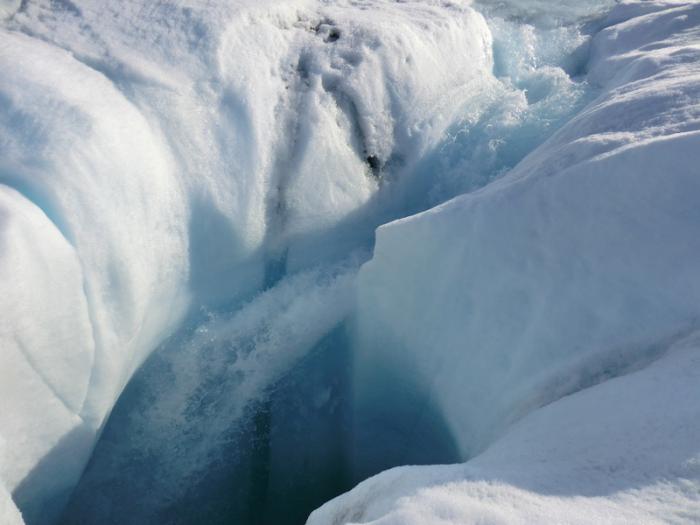
A river of meltwater on the Greenland ice sheet. Photo: Marco Tedesco
A stream of meltwater flows across the Greenland ice sheet. Photo: Marco Tedesco

“How much and where Greenland melts can change depending on how things change elsewhere on earth,” said lead author Marco Tedesco, a research professor at Columbia University's Lamont-Doherty Earth Observatory and adjunct scientist at NASA Goddard Institute for Space Studies. “If loss of sea ice is driving changes in the jet stream, the jet stream is changing Greenland, and this, in turn, has an impact on the Arctic system as well as the climate. It’s a system, it is strongly interconnected and we have to approach it as such.”

The Greenland ice sheet, earth’s second largest after Antarctica, holds enough ice that, if it were to melt entirely, it would raise average global sea level by about seven meters. Understanding the drivers of melting is critical to understanding how quickly and by how much sea level will rise in the future and how Greenland’s freshwater runoff will affect ocean circulation and ecology.

Northwest Greenland’s summer of melt
Northwest Greenland’s summer of melt started in June 2015, when a high-pressure ridge squeezed off from the jet stream, the study shows. It moved westward over Greenland until it sat over the Arctic Ocean and affected weather across the island through mid-July.
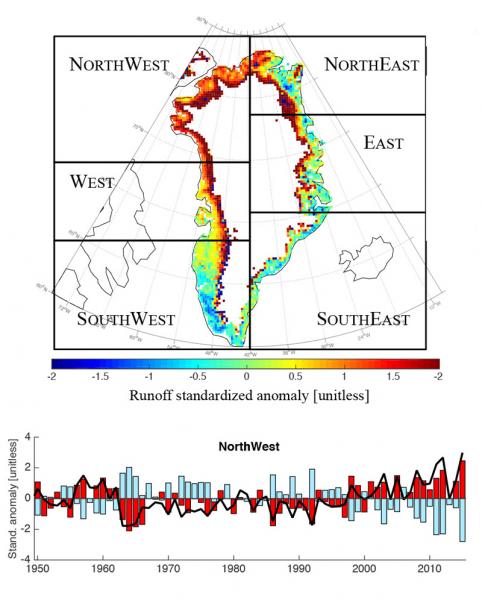
That high-pressure system, called a cut-off high, brought clear skies and warmed northern Greenland, helping set records for surface temperature and meltwater runoff in the northwest, the study shows. With less summer snow falling and melting underway, northern Greenland’s albedo, or reflectivity, also decreased. A less-reflective surface absorbs more solar energy, which feeds more melting, as Tedesco illustrated in a study earlier this year on the darkening of Greenland.
The map shows changes in runoff from the Greenland ice sheet during  July 2015 compared to the 1981-2010 mean. The bar chart focuses on  the northwest sector, showing standardized anomalies for mean July  runoff (black line), surface temperature (red bards) and surface  broadband albedo (blue bars) over time. Source: Tedesco et al., 2016
The map shows changes in runoff from the Greenland ice sheet during July 2015 compared to the 1981-2010 mean. The bar chart focuses on the northwest sector, showing standardized anomalies for mean July runoff (black line), surface temperature (red bars) and surface broadband albedo (blue bars) over time. Source: Tedesco et al., 2016.
 
Northern Greenland also set an unusual July record for wind: the winds blew east to west on average, rather the usual west to east; only two other years on record show easterly winds on average in July, both near zero. At the same time, the jet stream’s northernmost ridge swung farther north than ever recorded for that month, passing 76 degrees North latitude, nearly 2 degrees farther north than the previous July record, set in 2009, the authors write.

The same atmospheric pattern had a different impact on southern Greenland, where new melting records have been set over the past decade. The south saw more snow during summer of 2015 and less melting than previous years.

What drove the changes?
The authors stop short of confirming Arctic amplification as the cause of the warming, but they say the results fit the anticipated effects of Arctic amplification described by Jennifer Francis of Rutgers University and Stephan Vavrus of the University of Wisconsin in a 2012 paper.
Recent studies exploring the potential effects of Arctic amplification have showed that high-pressure blocks connected to northward swings of the jet stream have become more common near Greenland. Edward Hanna of the University of Sheffield, a co-author of the new Nature Communications paper, released a study in May using the Greenland Blocking Index to measure the strength of stationary high-pressure systems over the past 165 years and found that seven of the top 11 systems had occurred since 2007.

“The significant increase in Greenland high-pressure blocking that has occurred in the last 20 to 30 years is clearly related to recent record warming over the region, as well as jet-stream changes,” Hanna said. “This makes it more likely than not that within the next five to 10 years we will witness further record Greenland melt events like in 2012 and 2015.”

“The Arctic is full of climate surprises, and Greenland is a key player,” said James Overland, an oceanographer and climate scientist at the National Oceanic and Atmospheric Administration who was not involved in the new study. “Climate models suggest a 4 degree Celsius Arctic temperature increase by mid-century, but such jet stream related surprises acting on Greenland as reported by Tedesco et al. can accelerate Arctic climate change.”

Whether the patterns seen in 2015 will continue in the future remains to be seen. This spring, Arctic sea ice set another record low for its maximum extent for the year. "Greenland also experienced early season melt in early April of this year comparable to April 2012. Record setting melt occurred later that summer, but it is too early to tell whether the same will hold true in 2016,” said co-author Thomas Mote of the University of Georgia.

“The conditions we saw in the past aren’t necessarily the conditions of the future,” Tedesco said. “If humans change the forcing, we are going into uncharted territory.”

The other co-authors of the new paper are Xavier Fettweis of University of Liege; Jeyavinoth Jeyaratnam, James Booth, and Rajashree Datta of City College of New York; and Kate Briggs of University of Leeds. The study was supported by funding from NASA's Interdisciplinary Data Science Program, NASA’s Cryosphere Program and the National Science Foundation.

Source: https://www.ldeo.columbia.edu/news-events/greenland-set-melt-records-2015-consistent-%E2%80%98arctic-amplification%E2%80%99?platform=hootsuite

This article shows the reason why we should deal with climate change issue as soon as possible for our future.

What is Energy Engineering?

UC Berkeley introduced the energy engineering as follows.

<This informations are from UC Berkeley, http://engineeringscience.berkeley.edu/energy-engineering/
 
The Energy Engineering major interweaves the fundamental of classical and modern physics, chemistry, and mathematics with the energy engineering applications. A great strength of the major is its flexibility. The firm base in physics and mathematics is augmented with a selection of engineering course options that prepare the student to tackle the complex energy-related problems faced by society. Because the program emphasizes science and mathematics, students are well-prepared to pursue graduate studies in physics or engineering. Energy Engineering is a multidisciplinary field requiring an integration of physical principles with engineering analysis, augmented with the realities of policy and engineering economics. The program incorporates courses from many departments on campus to create a discipline that is rigorously based in science, mathematics, and engineering, while addressing a wide variety of environmental issues.
 
The Possibilities: Can pursue graduate studies in Energy Systems, Renewable Energy, Sustainability, Environmental Engineering, Solar Engineering.
 
Job Opportunities: Green Energy, Photovoltaic Engineering, Energy Systems, Energy Generation, Storage, Consumption and Transmission, Fuels Engineering, and Clean Energy Specialties.
 
To summarize, Energy Engineering takes a variety role. Specifically, in order to deal with climate change, energy engineering develops renewable energy and raise the efficiency of energy. Also it deal with carbon emission by developing certain technology like Carbon Capture and Storage

What is international Development Studies?

The International Institute of UCLA introduced the international development studies as follows.

<This informations are from UCLA, http://web.international.ucla.edu/institute/idps/ids/
 
About IDS
The International Development Studies Program, founded in July 1987, offers UCLA undergraduates an interdisciplinary education on the critical issues, problems, and achievements common to developing regions of the world.
 
Our curriculum emphasizes global- and regional- scale perspectives, as well as an array of themes to pursue (political- economy, cultural-aesthetic, and private sector development). This Bachelor of Arts degree is designed for students interested in careers or vocations requiring an understanding of the diverse development experiences of the world.
- Interdisciplinary Major
- Study abroad and internship credit may fulfill major requirements

- Small core courses and senior seminar
- Senior Thesis option that leads to Departmental Honors
- Students must  apply
 to be admitted during Fall of their Junior Year

Events and workshops sponsored by the IDS Program.
 
SCOPE OF THE MAJOR
IDS students' educational experiences are balanced between applied, field case-study learning and theoretical, conceptual knowledge. We believe strongly that these two types of learning are inseparable, and are useful for work in academia, government agencies, private industry, or non-governmental and non-profit organizations.  Most importantly, the program assists students in developing critical thinking skills with insight into, and knowledge of, the complex and diverse world community.
Interdisciplinary Approach: Our approach enables students to address urgent global issues from several different academic perspectives. Ranging from Anthropology to Economics, Public Health to Women's Studies, Geography to History, and Political Science to Sociology, our curriculum exposes students to the concerns of the developing countries within Asia, Eastern Europe, Africa, the Middle East, and Latin America. An understanding of these issues is indispensable for both practical and scholarly purposes. While encouraging the acquisition of theoretical and conceptual knowledge, the program is equally concerned with their practical application to global realities.
 
FIELD EXPERIENCE AND STUDY ABROAD
The program values field experience involving travel, study and/or work in regions in the Developing World. Thus a strongly encouraged (though not required) aspect of the major is study abroad, especially in a developing area, and intern in a local, national, or international community development agency/organization. 
 
THEMES 
Common topics of concern to students in International Development Studies major include:
  • The History of International Economic Expansion
  • Development Theory & Aid Institutions
  • The Consequences of Rapid Urbanization
  • Population-Resource Issues
  • The Transfer of Resources
  • Conflict Resolution
  • Human Migration & Refugee Relief
  • War and Political Violence
  • Health, Illness, and Health Services
  • Food Security & Self-Sufficiency
  • Human Rights & Environmental Justice
  • Political Stability & Democratization
  • Survival of Indigenous Societies
  • Conflicts between Modernity & Tradition
  • Inequalities of Wealth & Power at all Levels
  • Relationships between Development & Underdevelopment
  • Cultural Identity and Cultural Production
  • Gender Disparities in the Developing World

 To summarize, international development studies covers the both theoritical and practical studies. It covers lots of field that people in the developing contries need such as health, violence issue and etc. So I believe this study aims to understand the needs of each people who need assistance somehow and how to deal with issue. Therefore, it emphasizes the understanding of all the different circumstances that each local community faces.

Saturday, June 11, 2016

Research Outline

1) The purpose of Essay

This essay aims to share the notion that combination of International Development Studies and Energy Engineering will enhence the better mitigation and adaptation action which is devised to deal with climate change. Firstly understanding the circumstances of certain area where international support is required by using international development studies, and than secondly implementing the devised method which is appropriate for each single location by using Energy Engineering will lead to an successful action toward responding to climate change


2) Research Question

1.What is international development studies and how it can be used?

2. How can I find out the examples?

3. What are the places which require international aid to deal with climate change and how? 

4. How to combine the international development studies and energy engineering for constructive results?

5. Expected results of combination of both studies

3) Writing Method

1. Show the current aspect of climate change
2. Show the the examples
3. Show what is international development studies and Energy Engineering
4. Prove why the combination of  international development studies and Energy Engineering is required
5. Devised example for this and its future positive impact

 5) Research Plan

5/22~6/10 : Devise general research plan
6/11~6/17 : Research on examples
6/18~6/23 : The case study of combination of technology and international development studies
6/24~6/30 : 1st draft
6/31~7/2 : Self-Feedback
7/4~7/12: 2nd draft
7/13~7/17: Revise
7/18~7/22: Final draft and Presentation

 6) Connection to Science and Non-Science in Liberal Education

As mentioned on the paper, which emphasized the combination of each studies, it will show how each different studies can be combined together, in constructive way, which will bring much positive impact than expected

My Opinon on this topic (Brainstorming)


My Opinion: The importance of international development studies is not widely known in Korea. However, as this study helps to understand the needs of the certain place that require support and find out appropriate method for them, the importance of the study is being emphasized gradually. For climate change, as it is important to decide whether mitigation or adaptation is required, understanding of the place which needs support by using international development studies is crucial. Also Energy Engineering is practically important since it helps to implement lots of devices to reduce carbon emission or to deal with certain incidents and natural disaster casued by climate change.